Ethan Dewald
Ethan has always had a passion for the outdoors, particularly in the oceans. Living landlocked for most of his early life, he was delighted when his family moved to Cape Cod, Massachusetts. After completing high school in rural Pennsylvania, Ethan completed a Bachelor of Science double majoring in Biology and Environmental Science at the College of William & Mary in Williamsburg, VA, concentrating on marine ecology and conservation.
While completing his undergraduate degree, Ethan took part in several research projects in ecology, including a crayfish population survey in the Lake Matoaka watershed via baited trap and netting methods, a camera trap wildlife survey via photo/video analysis, and invasive blue catfish osmoregulatory and electroreceptory capacity in the Chesapeake Bay. Ethan served as a research intern at the Bimini Biological Field Station, or “Sharklab”, in South Bimini, the Bahamas, where he spent his days diving and photographing many shark species, including the endangered Great Hammerhead.
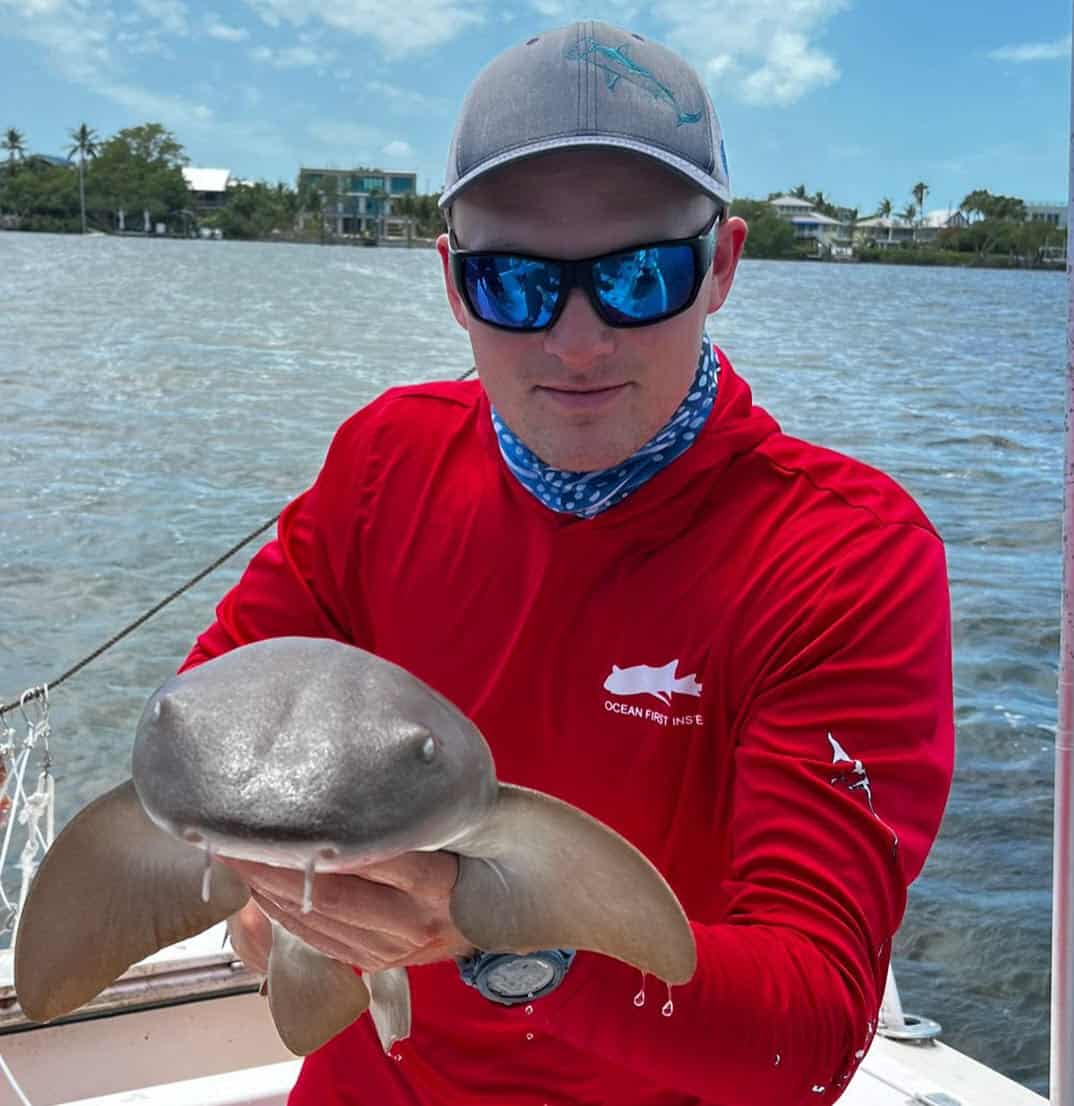
While working as a marine science instructor at MarineLab Environmental Education Center in Key Largo, FL, Ethan started working with Ocean First Institute (OFI), where he helped OFI establish their Keys Shark Lab in Key Largo and assisted with research projects on elasmobranch population and health in the Upper Keys, Goliath Grouper conservation in South Florida, microplastic awareness, and elasmobranch health in response to the spinning fish condition. While working with OFI, he conducted field work for his Master of Science degree at Florida Atlantic University with Drs. Chris Malinowski and Stephen Kajiura. His thesis investigated habitat influence and methodology limitations for estimating elasmobranch diversity and abundance in the understudied Upper Florida Keys region.
Since completing his Masters degree, Ethan continues to work with OFI as a scientific advisor and ambassador. He continues to give his expertise in fisheries science, baited remote underwater video (BRUV) surveys, and utilizing unmanned aerial vehicles (UAV) to contribute to elasmobranch conservation. He also enjoys staying involved in OFI’s research and outreach initiatives and continuing to assist with teaching the next generations of scientists and inspire positive action and contribution towards conserving wildlife and protecting the world’s oceans.